
Pricing
Pricing information has not been added yet.
Overview
TiDB is an open-source distributed SQL database designed for applications that need horizontal scalability, strong consistency, and MySQL compatibility. It separates compute and storage, automatically distributes data across nodes, and supports both transactional and analytical workloads, making it useful for large-scale online services and data-intensive applications that outgrow a single relational database server.
TiDB provides familiar SQL and ecosystem compatibility while adding distributed replication, fault tolerance, elastic scaling, and hybrid transactional and analytical processing. It can be self-hosted or used through managed cloud offerings. Although not an AI product itself, TiDB can support AI applications that require reliable operational data, large-scale metadata, or analytical access alongside normal transactions. It is best suited to engineering teams that want relational semantics without giving up distributed scale.
README


TiDB
TiDB (/’taɪdiːbi:/, "Ti" stands for Titanium) is an open-source, cloud-native, distributed SQL database designed for high availability, horizontal and vertical scalability, strong consistency, and high performance.
Key Features
-
Distributed Transactions: TiDB uses a two-phase commit protocol to ensure ACID compliance, providing strong consistency. Transactions span multiple nodes, and TiDB's distributed nature ensures data correctness even in the presence of network partitions or node failures.
-
Horizontal and Vertical Scalability: TiDB can be scaled horizontally by adding more nodes or vertically by increasing resources of existing nodes, all without downtime. TiDB's architecture separates computing from storage, enabling you to adjust both independently as needed for flexibility and growth.
-
High Availability: Built-in Raft consensus protocol ensures reliability and automated failover. Data is stored in multiple replicas, and transactions are committed only after writing to the majority of replicas, guaranteeing strong consistency and availability, even if some replicas fail. Geographic placement of replicas can be configured for different disaster tolerance levels.
-
Hybrid Transactional/Analytical Processing (HTAP): TiDB provides two storage engines: TiKV, a row-based storage engine, and TiFlash, a columnar storage engine. TiFlash uses the Multi-Raft Learner protocol to replicate data from TiKV in real time, ensuring consistent data between the TiKV row-based storage engine and the TiFlash columnar storage engine. The TiDB Server coordinates query execution across both TiKV and TiFlash to optimize performance.
-
Cloud-Native: TiDB can be deployed in public clouds, on-premises, or natively in Kubernetes. TiDB Operator helps manage TiDB on Kubernetes, automating cluster operations, while TiDB Cloud provides a fully-managed service for easy and economical deployment, allowing users to set up clusters with just a few clicks.
-
MySQL Compatibility: TiDB is compatible with MySQL 8.0, allowing you to use familiar protocols, frameworks and tools. You can migrate applications to TiDB without changing any code, or with minimal modifications. Additionally, TiDB provides a suite of data migration tools to help easily migrate application data into TiDB.
-
Open Source Commitment: Open source is at the core of TiDB's identity. All source code is available on GitHub under the Apache 2.0 license, including enterprise-grade features. TiDB is built with the belief that open source enables transparency, innovation, and collaboration. We actively encourage contributions from the community to help build a vibrant and inclusive ecosystem, reaffirming our commitment to open development and accessibility for everyone.
Quick Start
-
Start a TiDB cluster.
-
On local playground. To start a local test cluster, refer to the TiDB quick start guide.
-
On Kubernetes. TiDB can be easily deployed in a self-managed Kubernetes environment or Kubernetes services on public clouds using TiDB Operator. For more details, refer to the TiDB on Kubernetes quick start guide.
-
Using TiDB Cloud (recommended). TiDB Cloud offers a fully managed version of TiDB with a free plan, no credit card required, so you can get a free cluster in seconds and start easily: Sign up for TiDB Cloud.
-
-
Learn about TiDB SQL: To explore the SQL capabilities of TiDB, refer to the TiDB SQL documentation.
-
Use a MySQL driver or an ORM to Build an App with TiDB.
-
Explore key features, such as data migration, changefeed, vector search, HTAP, disaster recovery, etc.
Need Help?
-
You can connect with TiDB users, ask questions, find answers, and help others on our community platforms: Discord, Slack (English, Japanese), Stack Overflow, TiDB Chinese Forum, X @PingCAP
-
For filing bugs, suggesting improvements, or requesting new features, use Github Issues or join discussions on Github Discussions.
-
To troubleshoot TiDB, refer to Troubleshooting documentation.
Architecture
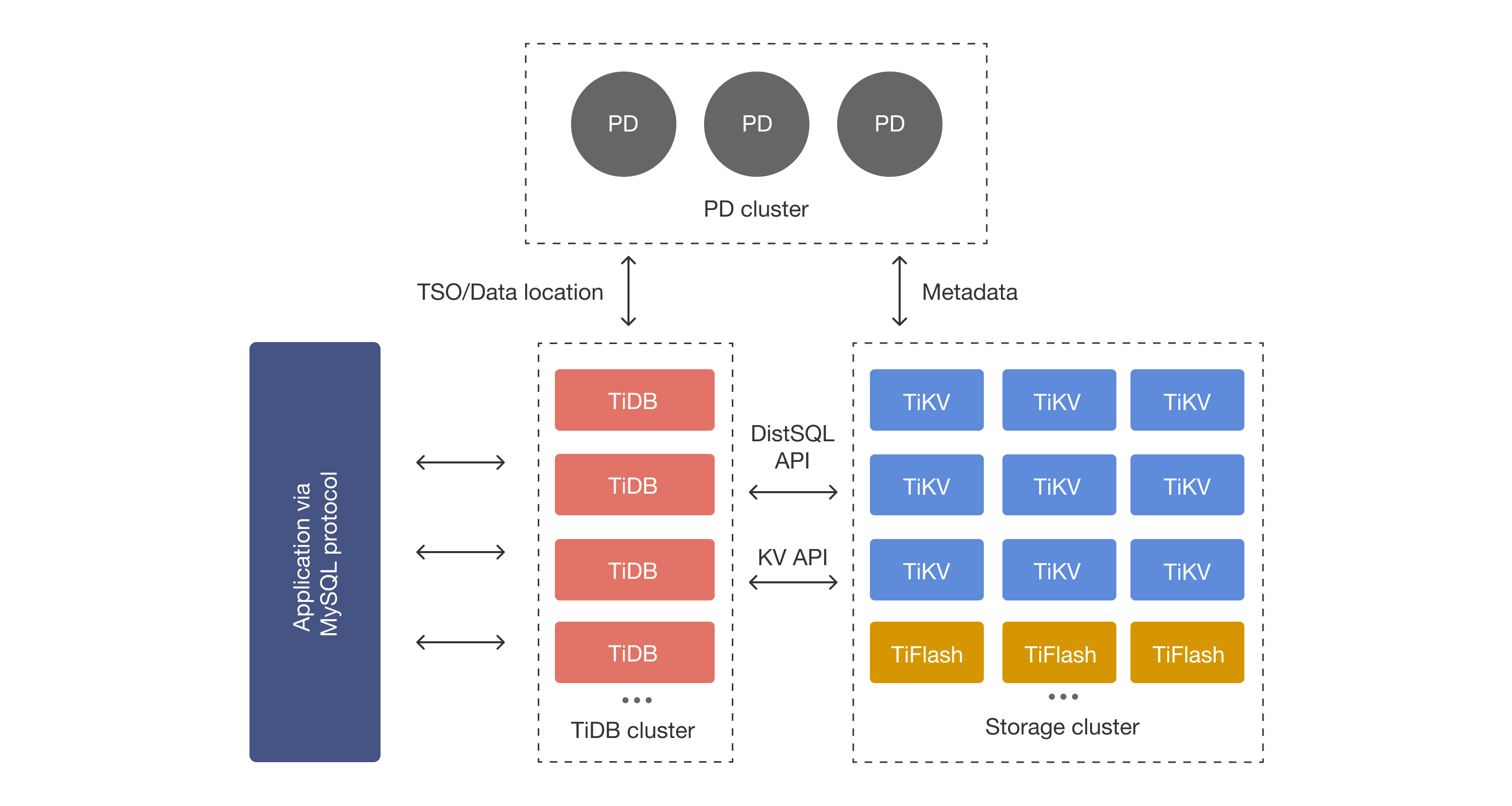
Learn more details about TiDB architecture in our Docs.
Contributing
TiDB is built on a commitment to open source, and we welcome contributions from everyone. Whether you are interested in improving documentation, fixing bugs, or developing new features, we invite you to shape the future of TiDB.
-
See our Contributor Guide and TiDB Development Guide to get started.
-
If you're looking for issues to work on, try looking at the good first issues or help wanted issues.
-
The contribution map lists everything you can contribute.
-
The community repository contains everything else you need.
-
Don't forget to claim your contribution swag by filling in and submitting this form.

License
TiDB is under the Apache 2.0 license. See the LICENSE file for details.
See Also
- TiDB Online Playground
- TiDB Case Studies: TiDB Customers, TiDB 事例記事, TiDB 中文用户案例
- TiDB User Documentation
- TiDB Design Docs
- TiDB Release Notes
- TiDB Blog
- TiDB Roadmap
Acknowledgments
Releases
Release information has not been added yet.
Complete your AI stack
Add complementary AI tools for the rest of your workflow.
More recommendations will appear here as matching tools are published.
Best alternatives
Compare similar tools in the same category.