
Pricing
$0
Freemium
Overview
all-in-rag is a full-stack practical guide to developing large-model applications with Retrieval-Augmented Generation (RAG). Contributors with experience in RAG, vector databases, Agentic RAG, or related technologies are invited to submit independent chapters to the Extra Chapter section after reviewing the contribution and PR guidelines.
The README covers RAG fundamentals and use cases; the complete data-processing workflow from loading and cleaning to chunking; embeddings, multimodal embeddings, vector databases, and index optimization; and advanced retrieval techniques such as hybrid retrieval, query construction, and Text2SQL.
README
All-in-RAG | Practical Large Language Model Application Development I: A Full-Stack Guide to RAG Technology
🔍 Full-Stack Guide to Retrieval-Augmented Generation (RAG)
From theory to practice, from fundamentals to advanced topics — build a complete RAG technology stack





| 🎯 Systematic Learning A complete RAG technology stack | 🛠️ Hands-on Practice Rich project examples | 🚀 Production Ready Engineering best practices | 📊 Multimodal Support Text + image retrieval |
Project Overview
This project is a full-stack RAG (Retrieval-Augmented Generation) tutorial for large language model application developers. Through a systematic learning path and hands-on projects, it aims to help developers master RAG application development with large language models and build production-grade intelligent question-answering and knowledge retrieval systems.
Main topics include:
- RAG Fundamentals: An accessible introduction to RAG's core concepts, technical principles, and use cases
- Complete Data Processing Workflow: The entire data preparation process, from data loading and cleaning to text chunking
- Index Construction and Optimization: Vector embeddings, multimodal embeddings, vector database construction, and index optimization
- Advanced Retrieval Techniques: Hybrid retrieval, query construction, Text2SQL, and other advanced retrieval techniques
- Generation Integration and Evaluation: Structured generation, system evaluation, and optimization methods
- Hands-on Projects: Complete RAG application development projects ranging from basic to advanced
Why This Project Matters
With the rapid development of large language models, RAG has become a core technology for building intelligent question-answering systems and knowledge retrieval applications. However, existing RAG tutorials are often fragmented and lack a systematic structure, making it difficult for beginners to develop a complete understanding of the technology.
Starting from practical applications and incorporating the latest developments in RAG technology, this project provides a complete RAG learning framework that helps developers:
- Systematically master the theoretical foundations and practical skills of RAG
- Understand the complete architecture of a RAG system and the role of each component
- Develop RAG applications independently
- Master methods for evaluating and optimizing RAG systems
Target Audience
This project is suitable for:
- Developers with basic Python programming skills who are interested in RAG technology
- AI engineers who want to learn RAG systematically
- Product developers who want to build intelligent question-answering systems
- Researchers interested in retrieval-augmented generation
Prerequisites:
- Basic knowledge of Python syntax and commonly used libraries
- Basic ability to use Docker
- Familiarity with basic LLM concepts (recommended but not required)
- Basic Linux command-line skills
Project Highlights
- Systematic Learning Path: Build a complete understanding of RAG technology, from fundamental concepts to advanced applications
- Theory and Practice Combined: Every chapter includes theoretical explanations and practical code examples to ensure effective learning
- Multimodal Support: Covers not only text-based RAG but also multimodal embedding and retrieval techniques
- Engineering-Oriented: Focuses on practical engineering challenges, including performance optimization and system evaluation
- Rich Hands-on Projects: Provides multiple projects ranging from basic to advanced to reinforce what you learn
Content Outline
Part 1: RAG Fundamentals
Chapter 1: Unlocking RAG 📖 View Chapter
- Introduction to RAG - Overview of RAG technology and use cases
- Preparation - Environment configuration and preparation
- Build RAG in Four Steps - Get started quickly with RAG development
- Appendix: Environment Deployment - Additional Python virtual environment deployment guide (Contributor: @anarchysaiko)
Chapter 2: Data Preparation 📖 View Chapter
- Data Loading - Processing and loading documents in multiple formats
- Text Chunking - Text splitting strategies and optimization
Part 2: Index Construction and Optimization
Chapter 3: Index Construction 📖 View Chapter
- Vector Embeddings - Detailed explanation of text vectorization techniques
- Multimodal Embeddings - Multimodal vectorization of text and images
- Vector Databases - Vector storage and retrieval systems
- Milvus in Practice - Hands-on multimodal retrieval with Milvus
- Index Optimization - Techniques for tuning index performance
Part 3: Advanced Retrieval Techniques
Chapter 4: Retrieval Optimization 📖 View Chapter
- Hybrid Retrieval - Combining dense and sparse retrieval
- Query Construction - Intelligent query understanding and construction
- Text2SQL - Converting natural language into SQL queries
- Query Rewriting and Routing - Query optimization strategies
- Advanced Retrieval Techniques - Advanced retrieval algorithms
Part 4: Generation and Evaluation
Chapter 5: Generation Integration 📖 View Chapter
- Formatted Generation - Structured output and format control
Chapter 6: RAG System Evaluation 📖 View Chapter
- Introduction to Evaluation - RAG system evaluation methodology
- Evaluation Tools - Common evaluation tools and metrics
Part 5: Advanced Applications and Hands-on Projects
Chapter 7: Advanced RAG Architectures (Extended Section) 📖 View Chapter
Chapter 8: Hands-on Project I 📖 View Chapter
- Environment Configuration and Project Architecture
- Implementing the Data Preparation Module
- Index Construction and Retrieval Optimization
- Generation Integration and System Integration
Chapter 9: Hands-on Project I Optimization (Optional) 📖 View Chapter
- Graph RAG Architecture Design
- Graph Data Modeling and Preparation
- Milvus Index Construction
- Intelligent Query Routing and Retrieval Strategies
Chapter 10: Hands-on Project II (Optional) 📖 View Chapter Planned
Extra Chapter
- Simple Neo4J Application (Contributor: dalvqw)
- Multimodal Omni Embedding Practice (Jina v5-omni) (Under optimization)
If you have valuable experience or specialized content related to RAG, vector databases, Agentic RAG, or related technologies, contributions as standalone chapters to the Extra Chapter section are very welcome. Before submitting, please read the Extra Chapter Contribution and PR Guide. Contributions will be evaluated based on completeness, practical depth, and reference value. Selected content may also be referenced or expanded upon in the main tutorial.
Directory Structure
all-in-rag/
├── docs/           # Tutorial documentation
├── code/           # Code examples
├── data/           # Sample data
├── models/         # Pre-trained models
├── Extra-chapter/  # Extended chapters and community practice content
└── README.md       # Project documentation
Hands-on Project Demos
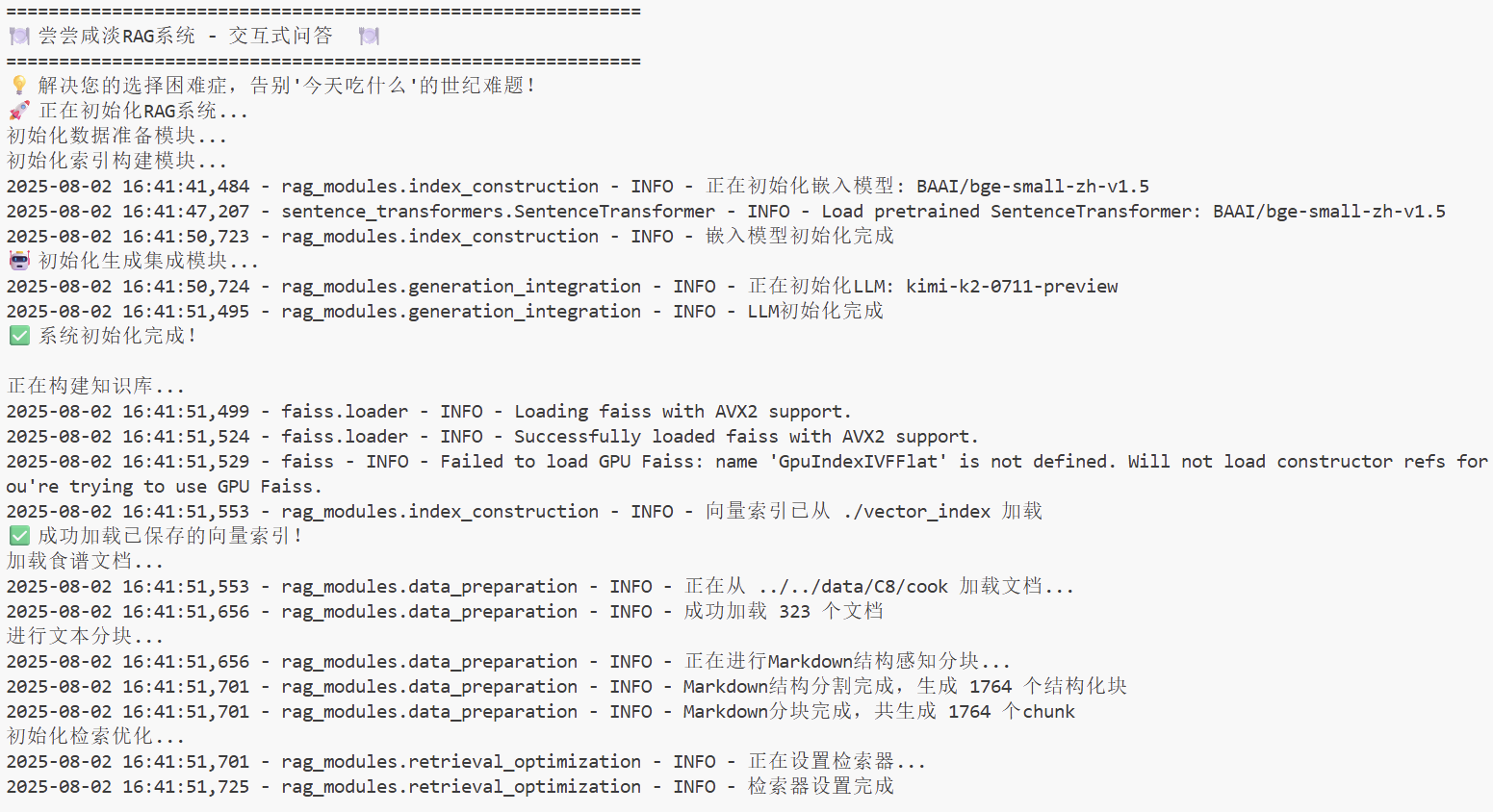
Chapter 8 - Project I:
Chapter 9 - Project I (Graph RAG Optimization):

Chapter 10 - Project II:
Acknowledgments
Core Contributor
- dalvqw - Project Lead (Project initiator and primary contributor)
Extra Chapter Contributor
- Sun Chao - Content Creator (Datawhale member - Shanghai University of Engineering Science)
Special Thanks
- Thanks to @Sm1les for their help and support with this project
- Thanks to all developers who have contributed to this project
- Thanks to the open-source community for providing excellent tools and frameworks
- Special thanks to the following developers who contributed to this tutorial!
Made with contrib.rocks.
Contributing
We welcome all forms of contributions, including but not limited to:
- 🚨 Bug Reports: If you find an issue, please submit an Issue
- 💭 Tutorial Suggestions: If you have ideas or suggestions, feel free to discuss them in Discussions
- 📚 Documentation Improvements: Help improve the documentation and example code (currently, PRs are accepted only for high-quality Extra Chapter content)
Star History

If this project is helpful to you, please give us a ⭐️
Help more people discover this project!

About Datawhale

Scan the QR code to follow Datawhale's official account and discover more high-quality open-source content
License

This work is licensed under the Creative Commons Attribution-NonCommercial-ShareAlike 4.0 International License.
Releases
Release information has not been added yet.
Complete your AI stack
Add specialist tools for research, coding, visual content, video, and automation.





Best alternatives
Compare similar tools in the same category.