
Pricing
$0
Freemium
Overview
AISystem is an open course about AI systems and the full low-level technology stack behind AI, including AI chips, AI compilers, inference systems, and training frameworks. The course is also known as AI System (AISys). Newer large-model material is maintained separately in the AIFoundation project.
The README highlights goals such as understanding the complete computer-system architecture behind AI through practical problems and case studies, learning system design across the AI lifecycle, and exploring research that combines modern systems architecture with AI. It also introduces mainstream frameworks, platforms, and tools used to build AI systems.
README
AI System & AI Infra
Because large-model content has grown substantially, the newest LLM material is maintained in AIFoundation.
The written course is continuously being expanded. Course materials are available through AISys, videos are hosted on Bilibili and YouTube, and the slides are open-sourced on GitHub.
Course background
The English name of this open course is AI System (AISys). It explores system design for artificial intelligence and deep learning, based on ZOMI's accumulated work building and organizing the full AI systems stack. The goal is to learn and discuss AI systems together with the open-source community.
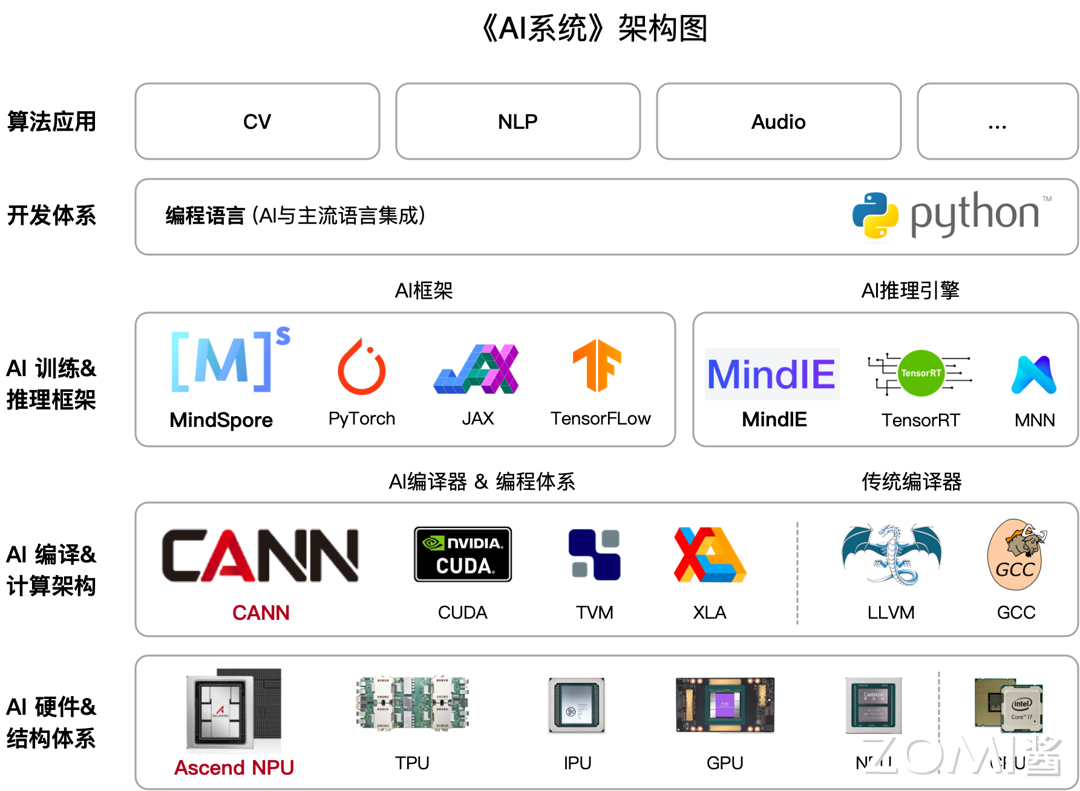
Course outline
The course contains five major modules:
| Module | Description | Link |
|---|---|---|
| AI systems full-stack overview | Fundamentals and a full-stack overview of AI systems, including systematic design methods for deep-learning systems and the overall architecture of AI training and inference. | [Slides] |
| AI chips and architecture | Hardware architecture for AI, from CPU/GPU fundamentals to AI chip principles, design, applications, middleware, frameworks, and practical usability. | [Slides] |
| AI programming and computing architecture | Compiler problems in modern machine-learning system design, especially intermediate representations and backend optimization. | [Slides] |
| AI inference systems and engines | Practical inference systems and engines, including core algorithms and engineering considerations required to deploy AI in real products. | [Slides] |
| Core AI framework technologies | Automatic differentiation, graphs and operators, frontend optimization, and key technologies for distributed large-model training. | [Slides] |
Course goals
The course is designed for senior undergraduates, graduate students, researchers, and AI systems practitioners. It aims to:
- Provide a complete understanding of AI computer-system architecture and system design across the full AI lifecycle through practical problems and case studies.
- Introduce research that combines modern system architecture and AI, together with mainstream frameworks, platforms, and tools.
Course sections
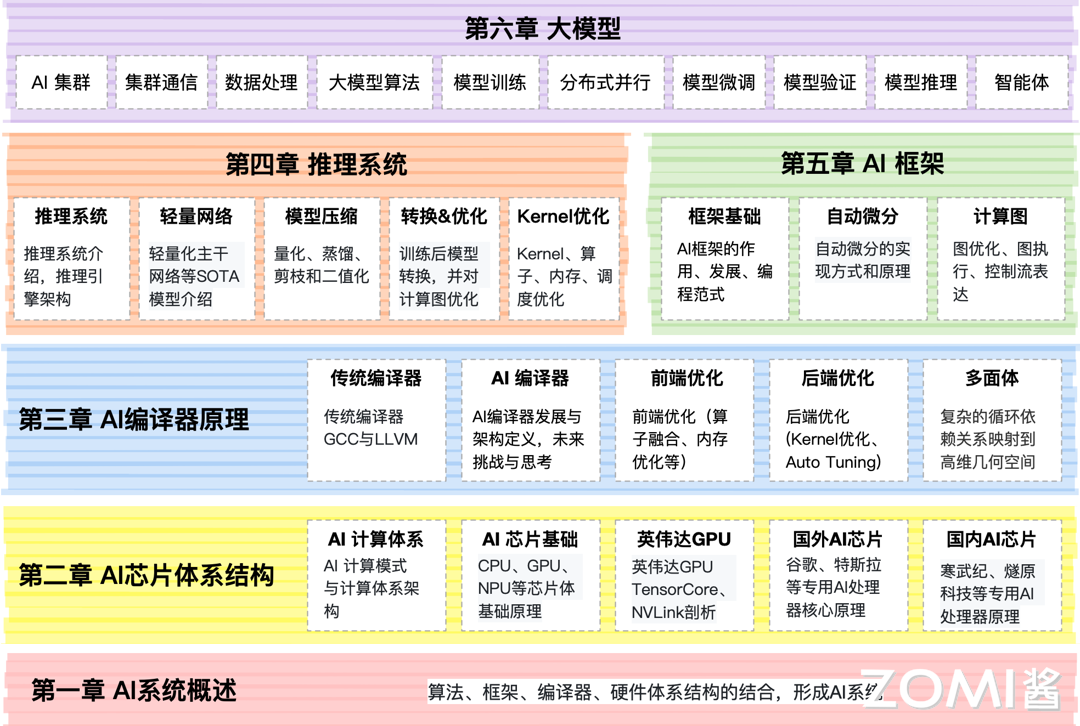
1. AI systems overview
| # | Topic | Content |
|---|---|---|
| 1 | AI systems | How algorithms, frameworks, and computer architecture combine into an AI system. |
2. AI chip architecture
| # | Topic | Content |
|---|---|---|
| 1 | AI computing architecture | Computing patterns and architectures for neural networks and other AI workloads. |
| 2 | AI chip fundamentals | Basic architecture principles of CPUs, GPUs, NPUs, and related processors. |
| 3 | GPUs | GPU fundamentals and the evolution of NVIDIA GPU architecture. |
| 4 | NVIDIA GPUs in depth | Tensor Cores, NVLink, and NVIDIA GPU architecture. |
| 5 | International AI processors | Core principles of specialized AI processors from companies such as Google and Tesla. |
| 6 | Chinese AI processors | Core principles of specialized AI processors from companies such as Cambricon and Enflame. |
| 7 | The golden decade of AI chips | A review of AI-chip programming models and development trends. |
3. AI compiler principles
| # | Topic | Content |
|---|---|---|
| 1 | Traditional compilers | GCC, LLVM, and LLVM architecture. |
| 2 | AI compilers | Evolution and architecture of AI compilers, future challenges, and open questions. |
| 3 | Frontend optimization | Operator fusion, memory optimization, and other frontend compiler techniques. |
| 4 | Backend optimization | Kernel optimization and AutoTuning. |
| 5 | Polyhedral compilation | Work in progress. |
| 6 | PyTorch 2.0 | The compilation technology stack introduced in PyTorch 2.0. |
4. AI inference systems
| # | Topic | Content |
|---|---|---|
| 1 | Inference systems | Overall inference-system concepts and inference-engine architecture. |
| 2 | Lightweight networks | Lightweight backbone networks such as MobileNet and other SOTA models. |
| 3 | Model compression | Quantization, distillation, pruning, and binarization. |
| 4 | Conversion and optimization | Converting trained models and optimizing their computation graphs. |
| 5 | Kernel optimization | Operator, memory, scheduling, and kernel-level optimization. |
5. Core AI framework technologies
| # | Topic | Content |
|---|---|---|
| 1 | AI framework fundamentals | The role, evolution, and programming paradigms of AI frameworks. |
| 2 | Automatic differentiation | Principles and implementation approaches for automatic differentiation. |
| 3 | Computation graphs | Graph concepts, graph optimization, execution, and control-flow representation. |
Knowledge checklist
Notes
The repository is around 10 GB because the author provides source production materials and high-resolution images. A full
git clonecan therefore be slow; using the Releases page to download only the material you need is recommended.
Community participation is welcome. Please report errors, submit fixes through pull requests, and respect the open-source work by clearly citing the source when reusing slide content.
Releases
Release information has not been added yet.
Complete your AI stack
Add complementary AI tools for the rest of your workflow.
More recommendations will appear here as matching tools are published.
Best alternatives
Compare similar tools in the same category.